Saturday, 15 June 2024

HOW TO BUILD A SHED: A COMPREHENSIVE GUIDE

Building a shed is a rewarding project that can provide extra storage space, a workshop, or even a small retreat. This guide will walk you through the steps to build a sturdy and functional shed, complete with sketches to illustrate the process.


PLANNING AND PREPARATION


  1. DETERMINE THE PURPOSE AND SIZE

Before you start, decide the primary purpose of your shed. This will help you determine the size and design features needed. Common sizes range from 6x8 feet for a small garden shed to 12x16 feet or larger for a workshop.


2. CHOOSE A LOCATION


Select a flat, well-drained area for your shed. Ensure it’s accessible and meets any local zoning regulations or homeowners' association rules.


3. GATHER MATERIALS AND TOOLS


Here’s a list of materials and tools you will need:


MATERIALS:

  • Pressure-treated lumber for the foundation
  • Framing lumber (2x4s)
  • Plywood or OSB for the floor and walls
  • Siding (T1-11, vinyl, or wood)
  • Roofing material (shingles or metal roofing)
  • Screws, nails, and wood glue
  • Doors and windows (optional)

TOOLS:

  • Tape measure
  • Level
  • Hammer or nail gun
  • Circular saw or miter saw
  • Drill
  • Square
  • Shovel
  • Ladder
  • Safety gear (gloves, goggles)

BUILDING THE SHED


STEP 1: BUILD THE FOUNDATION
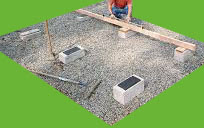

Here’s a basic sketch of the shed foundation layout.


  • Prepare the Site: Clear the area of debris and level the ground. Mark the shed's footprint using stakes and string.
  • Install the Foundation: There are several types of foundations you can use:
  • Concrete Blocks: Place concrete blocks at the corners and along the perimeter. Ensure they are level and spaced correctly.

  • Concrete Slab: Pour a concrete slab for a permanent foundation.

  • Wooden Skids: Use pressure-treated 4x4 or 4x6 skids for a movable foundation.


STEP 2: BUILD THE FLOOR FRAME


Floor framing layout.

  • Construct the Floor Frame: Use 2x6 or 2x8 lumber to create a frame that fits the shed’s dimensions. Space the joists 16 inches apart and secure them with nails or screws.
  • Attach the Floor: Cover the frame with ¾-inch plywood or OSB, securing it with screws.


STEP 3: BUILD THE WALLS


Wall framing layout.

  • Construct the Wall Frames: Build the wall frames using 2x4 lumber. Ensure the frames are square and the studs are spaced 16 inches apart.
  • Install the Walls: Erect the wall frames one at a time, securing them to the floor and to each other at the corners. Use temporary braces to hold the walls in place.


STEP 4: ADD SIDINGS AND WINDOWS


Wall with siding and window placement.

  • Attach Siding: Install your chosen siding material (T1-11, vinyl, or wood) to the wall frames. Make sure to cut out openings for windows and doors.
  • Install Windows and Doors: Fit windows and doors into the pre-cut openings, securing them with screws and caulking around the edges to seal them.


STEP 5: BUILD THE ROOF


Roof framing and layout.

  • Construct the Roof Frame: Build the roof trusses or rafters using 2x4 lumber. Ensure they are evenly spaced and secure them to the top plates of the wall frames.
  • Attach the Roof Sheathing: Cover the roof frame with plywood or OSB, securing it with screws.
  • Install Roofing Material: Apply roofing felt, then install shingles or metal roofing according to the manufacturer’s instructions.


STEP 6: FINISH THE SHED


Completed shed with all components.

  • Add Trim and Paint: Install trim around doors, windows, and corners. Paint or stain the shed to protect it from the elements and enhance its appearance.
  • Install Flooring (Optional): If desired, install additional flooring material like vinyl or laminate inside the shed.


TIPS FOR A SUCCESSFUL SHED BUILD


  • Follow Local Codes: Ensure your shed complies with local building codes and obtain any necessary permits.
  • Quality Materials: Use high-quality, pressure-treated lumber and weather-resistant materials to ensure your shed's longevity.
  • Accurate Measurements: Double-check all measurements and use a level to keep everything straight and square.
  • Safety First: Wear appropriate safety gear and work cautiously, especially when using power tools and working at heights.


Building a shed is a manageable project for most DIY enthusiasts and can be a valuable addition to your property. With careful planning, the right materials, and attention to detail, you can create a shed that meets your needs and stands the test of time.


😁 Happy building! 😁


————————————————————————————

While every effort has been made to check the accuracy of this article, readers should always make their own checks.


The Author does not accept any responsibility for misstatements made or any misunderstandings arising from the information provided.

————————————————————————————

Thursday, 13 June 2024

MAJOR OVERHAUL IN UK LEASEHOLD SYSTEM: KEY REFORMS INTRODUCED IN MAY 2024


The UK property market witnessed a seismic shift in May 2024 as the government introduced extensive reforms to the leasehold system. These changes are poised to transform homeownership for millions, addressing long-standing issues and providing more rights, power and protection for leaseholders. 

Here’s a detailed look at the key reforms and their implications:


BACKGROUND: THE LEASEHOLD SYSTEM

The leasehold system in the UK has been a contentious issue for years. Under this system, homeowners purchase the right to occupy a property for a set number of years, while the land itself remains owned by a freeholder. This has led to numerous problems, including escalating ground rents, costly lease extensions, and opaque service charges. Leaseholders have often found themselves at a significant disadvantage, with limited rights compared to freeholders.


THE CATALYST FOR CHANGE

Mounting pressure from leaseholders, advocacy groups, and MPs culminated in the 2024 reforms. The government recognised the urgent need to address the imbalance of power and protect consumers from unfair practices. The reforms introduced in May 2024 mark a significant step towards a fairer, more transparent system.


KEY REFORMS

Abolition of Ground Rents: One of the most significant changes is the abolition of ground rents for new leasehold properties. Ground rents, which have been a source of financial strain for many leaseholders, will no longer be applicable for new leases. 

Existing leaseholders will also see their ground rents capped at a nominal amount, effectively nullifying the financial burden.


SIMPLIFIED LEASE EXTENSION PROCESS

Extending a lease has traditionally been a complex and expensive process. The new reforms simplify this, making it easier and cheaper for leaseholders to extend their leases. This includes the introduction of a standard formula for calculating the cost of lease extensions, providing greater transparency and predictability.


RIGHT TO MANAGE AND COLLECTIVE ENFRANCHISEMENT

Leaseholders now have enhanced rights to manage their own buildings or collectively purchase the freehold. This change empowers leaseholders to take control of their properties, ensuring better maintenance and management. The process has been streamlined, reducing the bureaucratic hurdles that previously made it difficult for leaseholders to exercise these rights.


BAN ON LEASEHOLD HOUSES

The reforms also prohibit the sale of new houses as leasehold properties, a practice that has been particularly controversial. This ensures that new homeowners automatically receive the freehold when purchasing a house, aligning the UK with the common practice in other countries where freehold ownership is the norm.


TRANSPARENCY AND REGULATION OF SERVICE CHARGES

Service charges, which cover the cost of maintaining communal areas and services, have often been a point of contention due to their lack of transparency. The new reforms introduce stricter regulations, requiring freeholders to provide detailed breakdowns of service charges and justify any increases. This move aims to prevent exploitation and ensure that leaseholders only pay for necessary and reasonable expenses.


IMPLICATIONS FOR LEASEHOLDERS AND THE PROPERTY MARKET

These reforms are expected to have far-reaching impacts:


INCREASE HOMEOWNERSHIP APPEAL

By addressing the financial and administrative burdens associated with leasehold properties, the reforms are likely to make homeownership more appealing and accessible to a broader range of people.

Enhanced Consumer Protection: The introduction of caps on ground rents and greater transparency in service charges offers leaseholders better protection against unfair practices.


MARKET ADJUSTMENTS

The prohibition of new leasehold houses and the simplification of lease extensions may lead to adjustments in property values and market dynamics, as freehold properties become more prevalent and leasehold properties potentially less complex to manage.


MOVING FORWARD

The May 2024 leasehold reforms represent a landmark change in the UK property market, addressing decades-old grievances and imbalances. 

While these changes are a significant step forward, ongoing vigilance and possibly further reforms will be necessary to ensure that the leasehold system continues to evolve in favour of fair and transparent homeownership.

As the new regulations take effect, both current and prospective homeowners will need to stay informed and possibly seek legal advice to fully understand their rights and obligations under the revamped system. 

The government’s commitment to reforming the leasehold system underscores a broader effort to create a more equitable housing market, benefiting millions of Britons in the years to come.

————————————————————————————
While every effort has been made to check the accuracy of this article, readers should always make their own checks.

The Author does not accept any responsibility for misstatements made or any misunderstandings arising from the information provided.
————————————————————————————


Monday, 10 June 2024

SHOULD YOU MOVE OR IMPROVE YOUR HOME? WEIGHING THE PROS AND CONS


Deciding whether to move to a new home or invest in improving your current one is a significant decision that involves various considerations. 
Both options come with their own set of advantages, disadvantages, and costs. 

Here’s a comprehensive look at the factors to consider when deciding whether to move or improve.


MOVING TO A NEW HOME


ADVANTAGES

  • New Opportunities: Moving to a new home can offer access to better job prospects, schools, amenities, and an overall improved quality of life. If your current area no longer meets your needs, relocating can provide a fresh start.
  • Better Fit: A new home can be tailored to your current lifestyle and future needs. Whether it’s more space for a growing family, a different layout, or a location closer to work, a new home can offer features that your current home cannot.
  • Modern Amenities: New homes often come with modern features and energy-efficient systems, reducing future maintenance costs and utility bills. This can lead to a more comfortable and cost-effective living environment.
  • Investment Potential: Moving to an area with rising property values can be a smart investment, potentially increasing your home's value over time.

DISADVANTAGES

  • High Costs: Moving involves significant expenses, including estate agent fees, legal fees, stamp duty (in the UK), removal costs, and potential renovations to prepare your home for sale. These costs can quickly add up, often reaching tens of thousands of pounds.
  • Emotional Stress: Leaving a familiar environment, neighbours, and routines can be emotionally taxing. Adjusting to a new area and building a new social network takes time and effort.
  • Uncertainty: The process of buying and selling a home is fraught with uncertainties. Market conditions, the timing of transactions, and potential complications during the sale or purchase can create stress and delays.
  • Market Dependency: The success of selling your current home depends on the property market. If the market is slow or values are declining, you might have to sell for less than expected or wait longer to find a buyer.


IMPROVING YOUR HOME


ADVANTAGES

  • Cost Efficiency: Home improvements can be more cost-effective than moving. Instead of incurring all the costs associated with buying a new home, you can invest in upgrading your current property to better suit your needs.
  • Personalisation: Renovating allows you to tailor your home to your specific tastes and requirements. Whether it’s adding an extension, modernising the kitchen, or creating an open-plan living space, improvements can make your home more functional and enjoyable.
  • Increased Property Value: Strategic improvements can increase the value of your home, potentially providing a good return on investment when you eventually decide to sell.
  • Stability: Staying in your current home means you can maintain your social connections, children’s schooling, and familiarity with the neighbourhood, reducing the upheaval associated with moving.


DISAVANTGES

  • Disruption: Home improvements can be disruptive and stressful. Living through construction work can be noisy, messy, and inconvenient, sometimes requiring temporary relocation.
  • Unexpected Costs: Renovations often come with unexpected costs due to unforeseen issues such as structural problems or delays. Budget overruns are common, so it's essential to plan for contingencies.
  • Limited Space: There’s only so much you can do to expand or improve your current property. If the fundamental size or layout doesn’t meet your needs, no amount of renovation will solve this problem.
  • Planning and Permissions: Significant home improvements often require planning permission and adherence to building regulations. This can involve a lengthy and bureaucratic process, with no guarantee of approval.


COST-COMPARISON


MOVING COSTS

  • Estate Agent Fees: Typically 1-3% of the sale price.
  • Legal Fees: Around £1,000 - £3,000.
  • Stamp Duty: Variable, depending on the property's value and location.
  • Removal Costs: Approximately £300 - £1,500 depending on distance and amount of belongings.
  • Mortgage Fees: Can include arrangement fees, valuation fees, and potential early repayment charges on your current mortgage.


HOME IMPROVEMENT COSTS

  • Extension: Costs can range from £1,000 to £2,000 per square metre.
  • Kitchen Renovation: Typically £5,000 - £20,000.
  • Bathroom Renovation: Usually £3,000 - £10,000.
  • Loft Conversion: Around £20,000 - £50,000.
  • General Updates (painting, flooring, etc.): £1,000 - £5,000.


CONCLUSION


Both moving and improving your home have their merits and challenges. The decision ultimately depends on your personal circumstances, financial situation, and long-term goals. If your current location and property can be modified to meet your needs, home improvements might be the way to go. 

However, if you’re seeking significant lifestyle changes or your current home cannot be adapted, moving may be the better option.

Careful consideration of all factors, including the emotional and financial implications, is crucial. Consulting with real estate professionals, financial advisors, and builders can provide valuable insights and help you make an informed decision that best suits your needs and aspirations.

————————————————————————————

While every effort has been made to check the accuracy of this article, readers should always make their own checks.


The Author does not accept any responsibility for misstatements made or any misunderstandings arising from the information provided.

————————————————————————————

Thursday, 6 June 2024

HOW TO: LOFT CONVERSION: Where do you start?


Looking to create more space in your home?


Are you considering utilising the wasted space in your loft?


An easy way to check this is to look at similar houses in your area and look for the signs of loft conversions.  If there is, then it is likely that or house could support a loft conversion.  This is no guarantee but it may provide a positive start to your project.  Ask neighbours etc for information and help on this.


The addition of a converted loft is a great solution if you need extra space and the addition of a habitable room can add value to your home.


The first step is to obtain some  expert advice from an architect to see what is possible and obtain an estimated timeline and cost to covert your loft.


DO I NEED PLANNING FOR A LOFT CONVERSION?


Firstly, an architect will be able to advise you on whether or not you require planning permission, i.e. to check if your loft conversion will be allowed under ‘permitted development rights.’  

Note: Permitted Development means you may not require planning permission and the ‘Permitted Development Right’ can be formally approved by your Local Authority, which we would recommend you do. 

See your recent article on Permitted Development, for further advice.


Permitted Development factors are:


  • A volume allowance of 40 cubic metres additional roof space for a terraced house.
  • A volume of 50 cubic metres additional roof space for detached and semi-detached houses.
  • Note: Any previous roof space additions must be included with this volume allowance.
  • No extension beyond the plane of the existing rook slope of the principal elevation that fronts a highway.
  • No extension to be higher than the highest part of the roof (chimneys etc should not be taken into account as the highest part of the existing roof).
  • Materials to be similar in appearance to the exiting house.
  • No additional roof space created, e.g. no verandas, balconies or raised platforms.
  • Side-facing windows to be obscure-glazed; any opening to be 1.7m above the finished floor level.
  • Roof extensions, apart from hip to gable ones, to be set back as far as practicable at least 20cm from the original eaves. 


Note:

Loft conversions are NOT permitted development for houses on designated land; Dwellings within Conversation areas, National Parks and areas of natural beauty, roof extensions are not permitted development and will require planning permission.


BATS

Work to your loft may affect bats and bats are a protected species so it may be necessary for a bat survey to be carried out as converting a loft may affect bats roofing. If bats are using the loft then a license will be required and an expert to advise on how they may be moved.  Please check with your Local Authority if this will be required.


BUILDING REGULATIONS


Building Regulations approval will be required even if your loft conversion does not require planning permissions, i.e. it qualifies as permitted development.


The Building Regulations cover the following items:

The structural strength of the new floor is sufficient.

The stability of the structure (including the existing roof) is not endangered.

Safe escape from fire.

safely designed stairs to the new converted loft floor.

The converted loft is thermal insulated to the correct level.

Reasonable sound insulation between the conversion and the rooms below.


STRUCTURE


The existing floor to the loft will need to be assessed as the whether it is safe to use as a functional floor.  Most loft space ‘floors' are made of ceiling joists that are not capable of taking the loadings that a habitable floor requires.   The easiest way to improve the stability of the floor is to install floor joists between the existing ceiling joists.


The roof will usually require additional supports.  If your loft space has trusses then purlin beams will need to be installed and the trusses removed.  To enable windows to be installed, i.e. rooflights or dormers, it may be necessary to remove some of the rafters. An architect and /or a structural engineer will be able to advise you on the structural requirements of converting your loft.


FIRE SAFETY


The main aspect that needs to be addressed in converting your loft is the provisions for fire escape.  If you are converting a bungalow roof space then you may be ok as the escape route can be fairly simple.  When converting a two-storey house loft you are creating a 3 storey house and the escape will need to be protected.  It may also be necessary for install additional fire protection to the existing parts of the house, i.e. this may involve installing fire-resisting doors and partitions to protect the stairway as it may be too dangerous to escape via the windows from the floors above the first floor.  Smoke alarms connected to the main electricity will need to be installed


Also, to ensure adequate fire safety, a new staircase will be needed.  It is advisable to install  proper staircase but in some situations  space saving stairs can be used but nor retractable stairs or ladders.


Before undertaking any work to your loft it is important to seek professional advice as there may be lots of factors that will need to be addressed to ensure that you create a safe usable space.


HOW MUCH DOES A LOFT CONVERSION COST?


The cost of a loft conversion is usually @20,000 to £45,000 but costs can vary considerably as it will depend on your house type and what exactly you require in the loft space.


HOW LONG DOES A LOFT CONVERSION TAKE?


A loft conversion typically takes approximately 28 weeks to complete.


An outline of the time is usually:

  • Design Development: 2-4 weeks.
  • Planning Permission (if required) 6-12 weeks.
  • Detailed Design: 4 weeks. (thins involves detailed drawings, structural drawings and calculations and Building Control Approval).
  • Appoint a Builder: 2-4 weeks.
  • Loft Construction: 8-12 weeks.


SUMMARY


Seek local knowledge on what has been achieved in similar houses to yours.

Remember:No two loft conversions are the same.  Properties differ (even ones that look like your house) and your requirements for the loft conversion  can affect the time to complete and the cost, compared to similar houses.


Seek the advice of a professional on what is possible etc.  An Architect is a great start and will get you the best possible loft conversion, they will also protect your finances and ensure that a building contract is in place with your builder and the construction is completed on time and budget.


————————————————————————————

While every effort has been made to check the accuracy of this article, readers should always make their own checks.


The Author does not accept any responsibility for misstatements made or any misunderstandings arising from the information provided.

————————————————————————————

DO I REQUIRE PLANNING PERMISSION?

Whether you need planning permission in the UK depends on the type of work you plan to carry out. Here are the key considerations: Permitted...